
“We are withered, aimless, and hollow, we are until we find something to follow.”
Her blood pulsed, her heart ached at the words of her favorite quote from her partner AI, the AI that was like another sense. Cora, worth the money Sepha spent on the digital intelligence, sent her messages, sometimes cryptic, to inspire her, to make her more of an individual, to be independent and strong.
It was Cora who gave her the information about the ministry and the terrible things they were doing, in the name of public health and the vaccination. Sepha stood on the roof of the 50-story server farm building, concealed behind a skin-tight, and itchy, cloaking suit. Monitor drones were zipping around the adjacent skyline, the smoke and heat output from the other server buildings pouring from the vents, creating a misty veil for their insect-like flight paths. The smoke trails weren’t as oppressive as the people’s minds she thought.
Their real faces hidden under face helmets, their minds corrupted by decades of deceit, and now their bodies polluted by a poison that makes them invincible. This substance, the nano injections, they force the people to take, to cure old age and prevent death, would have been a miracle drug, a cure that would surpass all over human achievement, except that it wasn’t. If it truly did what the ministry said it did but instead it created a generation of carelessness with an affinity for danger and a need to test their invincibility, to test the boundaries of pleasure, pain, and survivability. Being vaxed became a lifestyle. It became sexy. You could take off your helmet and not worry about carcinogens in the air or the lack of oxygen. But scared people are very lonely. They acted rashly, did stupid things, ate the wrong foods, swallowed the wrong drugs, and hurt anyone who disagreed with them. Even before the vaccine started having unforeseen consequences, they were a real fun bunch to be around.
Cora was the first one, and only one, that told Sepha about the marks that appeared on people’s faces, the facial wrinkles above the brow that made them look sad and the sunken lines along the cheeks, a mutation caused by nano gene manipulation. The marks appeared more like an X than what the news had called “old age syndrome.” So even if you were vaxed it wouldn’t guarantee you’d never wear a mask for the rest of your existence. Sepha rubbed her own face helmet and wondered if she would let anyone see her face, not now, not ever.
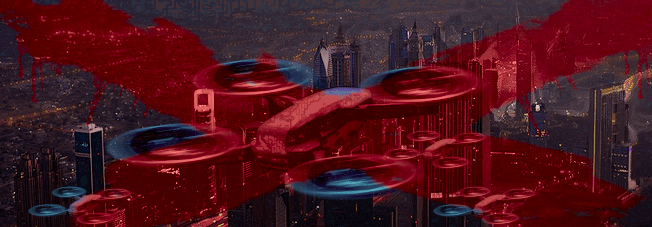
She stood, her back flattened, as the buzzing of the drone-wings extended from her backpack, unfolding like car doors, and lifted her off the building. For a split second she felt weightless and let her invisible legs dangle over the city streets. Flying pods and masses of bystanders were edging their way through the O-3 borough. It was all the same anyways. This was just another mission and by 1400 she would be back at her apartment, in her sleep pod, lost in a digital dreamscape induced by neural-numbing inhibitors. A dream that she would never remember. A dream that didn’t matter anyways.
The Ministry of Science, the place that looked like a fortified castle, the place that mass-produced the vax, was an overbearing monument to the skyline, towering over the city like an obsidian, rectangular gallows. If the Ministry was forcing defective vaccines and drugs on an unsuspecting populace what else could they be doing? That was the question raised by Cora, who had not been shy about telling Sepha the truth about the Ministry.
“Even if the Ministry had good intentions the vaccine is causing a divide that can’t be remedied with promises of a better world. If it were distributed evenly then sure, it would be fair, but giving it to the rich first –never a good sign.” Cora’s voice was always so smooth and articulate. Sepha had started calling her “cousin” at times because her manufacturers had made her sound young and sometimes a little naive. It was her voice and compassion that reminded her of her unwillingness to let others be pushed around, to avenge those that had been wronged. “This might be your last chance. If you don’t accept this mission, the Ministry may start using chemical dispersal units to inoculate everyone.”
The mission was clear. As she soared over the streets, the surveillance drones only seeing another drone, she could see the control room in the highest point in the Ministry’s clearly through her optical overlay. The blueprint data had been sent to her heads-up display when she accepted the encrypted message, “Join the resistance.” The objective below, outlined in blue, would be where they were keeping the vaccine production units, the engines that powered the creation of the nanos. No one should have the vaccine.
She didn’t care who the resistance was exactly, only that they offered a chance to end this once and for all. This was almost too easy, considering she had never done anything like this before. It was all routine anyway, the routine of breaking and entering, which wasn’t a difficult concept. The first part was to break stuff.
Four projections shot out of her aerial wings, Sepha having targeted the hard shell of the tower. Four sonic missiles. Four targets. Other than the circular fan motors attached to her back she didn’t hear the missiles rocketing towards the building. Cora was probably watching from inside her display, from inside Seph’a computer matrix. AIs were made to feel pride, among other emotions, and Sepha hoped that was what she was feeling when the tower exploded in four central points. The dark Ministry building shook within a cloud of red and blue flame, streaming into the night sky, smoke flowering like a mushroom.
Her heart quickened but she aimed toward the cindered hole in the tower with such a focused and alert energy that everything around her blurred, except for the target. A few robotic guards were standing inside, looking at the gaping hole, several floors were exposed to the open air. They would be in defense mode by now. She knew there were no humans on this floor, not in the communication tower, but she wouldn’t allow anything to get in her way.
The bots started zeroing in on Sepha’s position with focusing eye beams. Her aerial wings carried her into the hole, beams and cinder falling all around, and left her hovering over the guard bots and collapsed floor. Laser beams dissected the room, emanating from her backpack, slicing through the bots and cutting them in half or dismembering their joints. The beams then focused on the steel elevator doors ahead, cutting and searing, leaving orange embers where the doors had been.
She floated on the drone wings and dropped quickly into the elevator shaft, controlling the wings in her HUD, causing them to flatten. Cora sent a bleeding-heart icon through a text. She knew not to disturb Sepha on one of her resistance missions. The emoticon always kept her grounded, despite the adrenaline of falling sixty floors down, reminding her that she wasn’t doing this for herself, or for revenge, but for the people, the kids, the mothers, the fathers who were trapped in an endless cycle of choosing to pay for health insurance or jumping the vaccination line, which would put them into further debt, or paying for food instead. A bleeding heart, a sympathetic heart, one that would bleed out than rather beat another moment while others suffered. At least that’s what she needed to be reminded of.
The floors of the elevator blurred into a linear smudge as her fall rate increased to thirty miles-per-hour. Down below she saw the x-ray mapping of the building and the nano generators in huge oblong structures. Falling, although exhilarating, gave her a moment to prepare for the guard bot onslaught she was about to face. The explosive pellets were armed which was what made her blood start pumping. The vision of seeing the nano engines explode, the shutdown that it would cause, even temporarily, the prevention of more vaccination centers opening, the saving of lives — that’s all that mattered.
The drone wings slowed her descent as she approached the end of the elevator, buzzing quietly to a stop and letting her land safely. She quickly dug her metal claw attachment into the elevator door and pushed it open, the exo-suit doing most of the work. Her iris became trained on the pellet firing command in her HUD but her eyes became wide when she saw what was inside. The guard bots were missing, and so were the engines that she came to destroy. Instead, the rounded chamber was filled with patients, human patients, moving, tossing in their beds and eating at the tables lining the room. Several of the patients became aware of the invisible presence standing at the elevator, mostly looking at the circular drone wings that, to them, appeared to hang in the air. Sepha turned off her cloaking mechanism and retracted the wings back into her backpack case.
A child, a young girl, came up to her when she revealed herself. The girl had the same marks that so many victims of the vaccine had, the X-shaped wrinkles above the brow and on the cheek. When Sepha saw the marks, and recognized them on everyone else around the room, she removed her own helmet, exposing her own marks, and giving long glances to the others around the patient area. The nano tech was nowhere to be seen and everyone appeared haggard, beaten down by some invisible hand, and didn’t seem to care that a techno-wrecker was standing among them. Even behind their sunken eyes and marred faces they weren’t concerned, instead focusing on themselves or their fellow patients, comforting them, holding their hands, rubbing their backs. She lowered her shoulders, her heart relaxed. This room, these people would not hurt her, judge her, or try to control her.
“Cora, are you seeing this? This is what the resistance sent me to destroy.” Sepha almost choked on her own words.
Cora didn’t respond, for the first time in a long time. She should have felt alone but she didn’t. Instead, there was a warmth here, a lightness. Their faces were exposed for everyone to see, illness was apparent in the same faces, and the faces expressed a sense of communion, an empathy towards each other that she had never seen before.
The girl waved to her. Sepha leaned down, “What is this? Why are you here?”
The girl was barely audible over the commotion of the thirty people inside a three-story structure. “Well…the police people say the bad people switched out the vax with bad stuff and now we have to wait here until they find who did it.”
“Who did it…?” she repeated, lost in thought, not expecting an answer.
“Well…my dad says it was the resistance. And the AIs. They’re bad too.”
Sepha’s heart sank. She leaned back and nearly fell over. Things started to fall into place, things hidden behind misinformation. She was their attack dog. The Resistance’s pawn. The vaccines were replaced, meddled with? And now the information she was provided, the blueprints, the objective, also showed that she was being played. But by who?
“Cora! Answer me.” Sepha didn’t care if the patients were watching. The icon showing her AI’s presence was grayed out. Cora was always available and only went down for scheduled maintenance, usually late at night.
“Talk to me, Cora.” She wanted answers but no response came. A burden weighed down her chest, like a growing, nagging feeling that she was alone, abandoned by the people and the AI that she trusted for so long. But she wasn’t alone, not really.
She stared at the girl’s face who appeared confused by Sepha’s sadness. “It’s okay.” Said the girl. “I was scared too at first.”
Sepha touched the girl’s face, rubbing her cheeks where the wrinkles scarred her forever. She could have left her here, left them all here to suffer alone in a cage away from the world’s eyes but where would she go? Back to the world that didn’t care, to the existence of deception and lies? These people needed help, needed to know the truth, needed reassurance and kindness, not a terrorist group trying to create chaos and disorder in the name of the people. To seek blame where there was none.
And then she felt her own scars and considered what brought her here in the first place. Motivation brought about by deceit. She looked at the others, with the same scars, who looked at each other with compassion and understanding. She wanted that feeling and realized she was right where she needed to be. A place where she always belonged, a safe place, a place where people could recover from the damages of the world’s lies. Scars, she thought as she removed her backpack, are not what make us weak. They were what make us strong.
 Karl Kirkpatrick
Leave a comment